Translated from Portuguese by Claude. Leia o original em português · more in English
Open Claw, Personal Knowledge and the Second Brain
What got me back into programming wasn’t Claude or Codex. It was OpenClaw (in Portuguese). Not because of the personal assistant idea, but as a Second Brain. Or a Zettelkasten.
The bombardment of information, the excess of content, meetings, and notes has been a major challenge. Everything spawns threads in parallel in our brains, fragmenting attention. I needed to find a way to manage all that knowledge, links, videos, and notes.
I remember reading classic literature. Some of the great authors dictated what would be written, what was being thought. Dostoevsky did this (his second wife was his stenographer!), and other authors of long volumes drew maps that would look like our mind maps. I had the chance to see some at the Dostoevsky Museum in Saint Petersburg.

Personal Knowledge Management mechanisms are really nothing new. From personal wikis to Martin Fowler’s Bliki (although today it’s more of a blog).
We’ve seen the waves, right? From Delicious and Pocket, saving links and clippings, to Trello and Evernote, then Notion and Obsidian. The question remains: where do I scribble, annotate, summarize, store, and search?
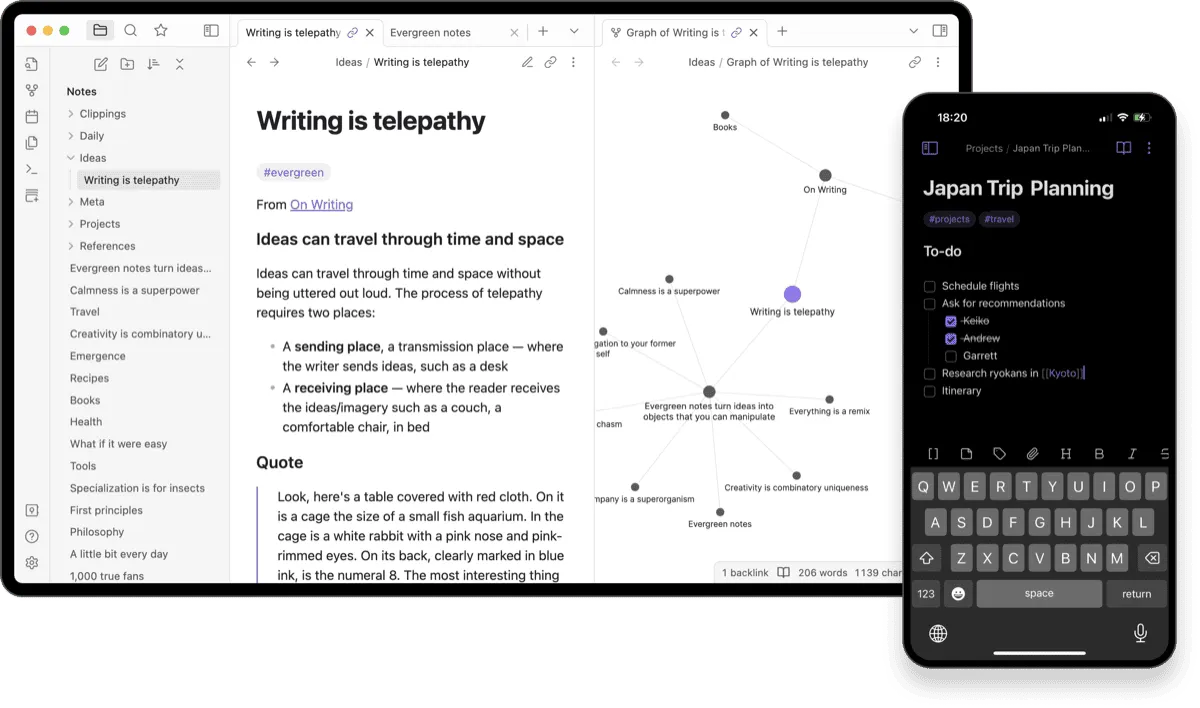
I tested several of these tools and realized none matched the workflow I had in mind. So I vibecoded my own solution. A Personal Knowledge Management system that, given everything I’ve recorded, noted, and reflected on, ultimately helps me write posts for this blog.
Yes, products like mem.ai do something similar. But in the world of disposable software, it’s more interesting to have something extremely customized to my needs. And what are those needs?
- Record audio, text, images, and ideas immutably
- Classify that data into labels
- Generate concepts: Knowledge Base (KB) nodes
- Use a KB node to create or append to a blog draft
It’s a specific piece of software deployed on Fly.io, listening to a Telegram bot via a simple webhook and BotFather. It calls Whisper via OpenAI and Anthropic (Sonnet) to classify and synthesize the text, always respecting what I actually said, never inventing words.
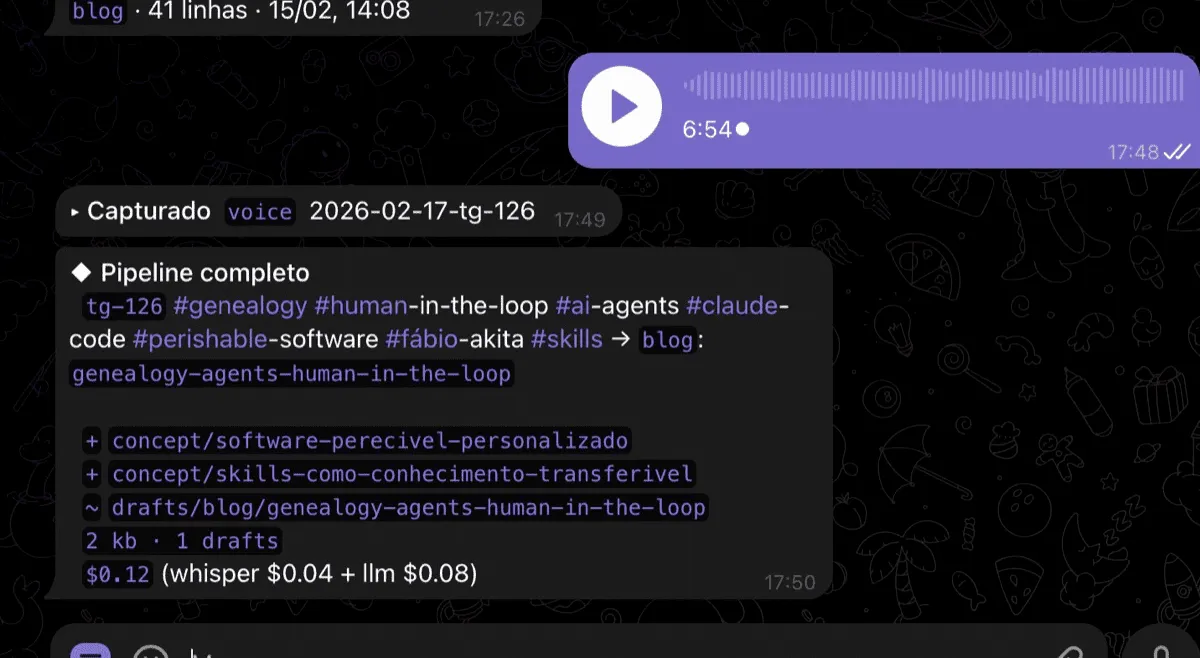
With this small system I can record voice notes, even out of order, on different days. The journaling is the single source of truth with the direct transcription. From that journaling, concepts are generated (Knowledge Base nodes) and classified. The journaling can also enrich a blog draft, concatenating the selected transcription of a Concept if it’s classified as such. There are many other details, like the classifier receiving the current concepts and drafts as candidates, and a glossary being built over time so Whisper can handle terms and acronyms I use frequently.
Could I do something like this via OpenClaw? I imagine so. I doubt the result could be kept within an expected structure. Small agents for specific cases should work better than a do-everything agent. At least for now.
I asked for help with a diagram to better explain what I’m doing programmatically:
Then, with these drafts, I refine the articles myself, because there’s too much repetition, gaps, and the ideas never fit together neatly.
I could try to leave that concatenation of ideas and text restructuring to the machine: ask the LLM to take this pile of messy notes and create a publish-ready article. I won’t. The LLM, no matter how “humanized,” would change too much information and create content from its own “head,” giving off that slop feel we see everywhere now, where everything looks like anything. It would also lose authenticity in a noticeable way.
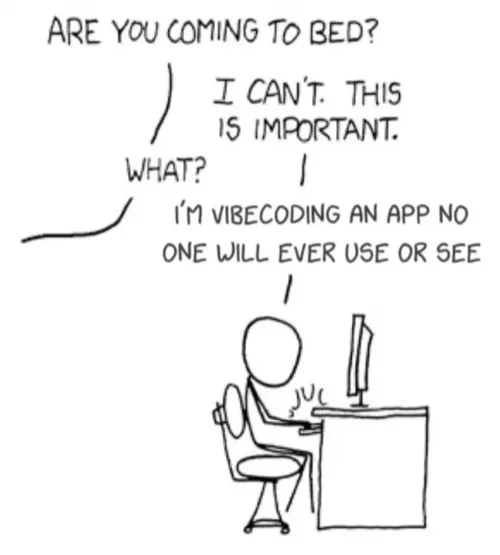
And to give you an idea, I wrote this post through several fragments and voice notes I recorded over the course of days, ordered quite differently from how they appear (some I removed):
1. Intro: OpenClaw, Second Brain, Zettelkasten, waves of tools 2. tg-121: PKM history: wiki, Bliki, Zettelkasten/Luhmann 3. tg-29: Broad context: info overload, Markdown, LLMs, Obsidian, SaaS 4. tg-29: Dostoevsky as the original second brain, Meta/Zuckerberg, fragility 5. tg-106: The concrete system: Telegram → Whisper → Fly.io → Anthropic 6. tg-30: Voice journaling workflow (record, transcribe, refine) 7. tg-129: Image (bot screenshot) 8. tg-149: Meta-reflection: this post was built by the system, human curation, disposable software 9. tg-132: Vibecoding meme 10. tg-34: Human-machine symbiosis 11. tg-34: The prompt injection paradox (provocative ending)Did it cut my working time a lot? No. I’ve been at this draft for hours. But now I no longer lose ideas and texts I’d like to study or share.
PS (September 2026): I no longer use this solution this way. My usage today is much more pragmatic and simpler, as I tell in my personal knowledge system after six months (in Portuguese).
The discussion (9 comments, in Portuguese) is on the original post.
More in English
- Archetypes instead of professions note · Sep 28, 2026
- AGI, exponentiality and superintelligence note · Sep 25, 2026
- Human Out of the Loop, Asimov and Gradual Disempowerment post · Sep 24, 2026
- My personal knowledge system after six months note · Sep 23, 2026
- Fred Brooks, Fowler and what doesn't change in the profession note · Sep 16, 2026