Translated from Portuguese by Claude. Leia o original em português · more in English
Human relationships: Bill Gates, Anthropic and the Pope
Bill Gates wrote an interesting post about artificial intelligence: the risks, the benefits and how he thinks we should act. I did a full reading of it on Hipsters #531, my podcast (in Portuguese). It is interesting to see how this article contrasts with the pure optimism of “The Future is for Everyone”, which Mark Zuckerberg, from Meta, also published a few weeks ago.
In the part about education, Gates stresses the importance of productive struggle, so that cognition is always put to use, and not outsourced as a mental prosthesis (in Portuguese):
Ironically, the same tool that will allow people to learn more than ever could also lead to many people learning less.
For students, an AI tool that preserves what researchers call “productive struggle”—the cognitive work that builds understanding—can strengthen learning. When a student first encounters a new idea, the AI gives substantive explanations and offers both questions and answers. Later, when it’s checking their comprehension, it holds the answer back and helps them arrive at it on their own.
I like the trivial example of the calculator: when introduced too early, the child is kept from understanding the different strategies to find their own way of doing that calculation. Sparing the brain this friction is a mistake, one that reduces productive struggle. It is what we have been seeing in several articles: from the ones cited by Paulo Blikstein (in Portuguese) to the recent Chinese study that followed two years of AI use among students, showing the advantage in homework and the drop in performance on in-person exams, as expected.
Gates cites several obvious problems: jobs, the economy, the risk of bioweapons. He gives a focus that lives among my own worries: human and social relationships, and how children will grow up in a world where bonds and friendships are already rarer and rarer.
When I was growing up in Seattle, I didn’t have that many friends aside from a few other boys who were like me. It took hard work and a lot of help from my mom to develop my social skills so I could relate to different kinds of people. I still draw on those lessons today at the age of 70.
I doubt I would have put in the same work if I had had an AI companion back then. They talk to you in ways you’re already comfortable with. They don’t push you outside your comfort zone. They are always available and never get mad at you. This gives them the potential to become highly addictive and to rob us of the lessons we learn from connecting with other people.
Quoting Jonathan Haidt, from The Anxious Generation:
“Like young trees exposed to wind, children who are routinely exposed to small risks grow up to become adults who can handle much larger risks without panicking. Conversely, children who are raised in a protected greenhouse sometimes become incapacitated by anxiety before they reach maturity.”
An AI companion designed to never upset you is a big, protected greenhouse.
Another proposal from Bill Gates: creating a mechanism of reserves. Just as we have parks that are nature reserves, we would have human reserves: some jobs, places, regions and professions where the robot doesn’t act, because that will be important to keep our humanity.
My dad died of Alzheimer’s in 2020. In the later stages of his illness, he was cared for day and night by paid caregivers who understood him even when he struggled to express himself. […] Something in the care they gave my dad was irreplaceably human. No robot could or should have done it.
I like the phrase Human Reserved because it makes me think of nature reserves—places where we could put buildings and roads, but we choose not to because the loss would be too great.
Wherever we draw the line, Gates says, that decision should be ours, made intentionally: we need to be in control of the technology, and not just let it roll. And it is Gates himself who points to the Vatican:
I was fascinated by Pope Leo XIV’s encyclical on AI, “On Safeguarding the Human Person in the Time of Artificial Intelligence.” It lays a strong foundation for the work that needs to be done.
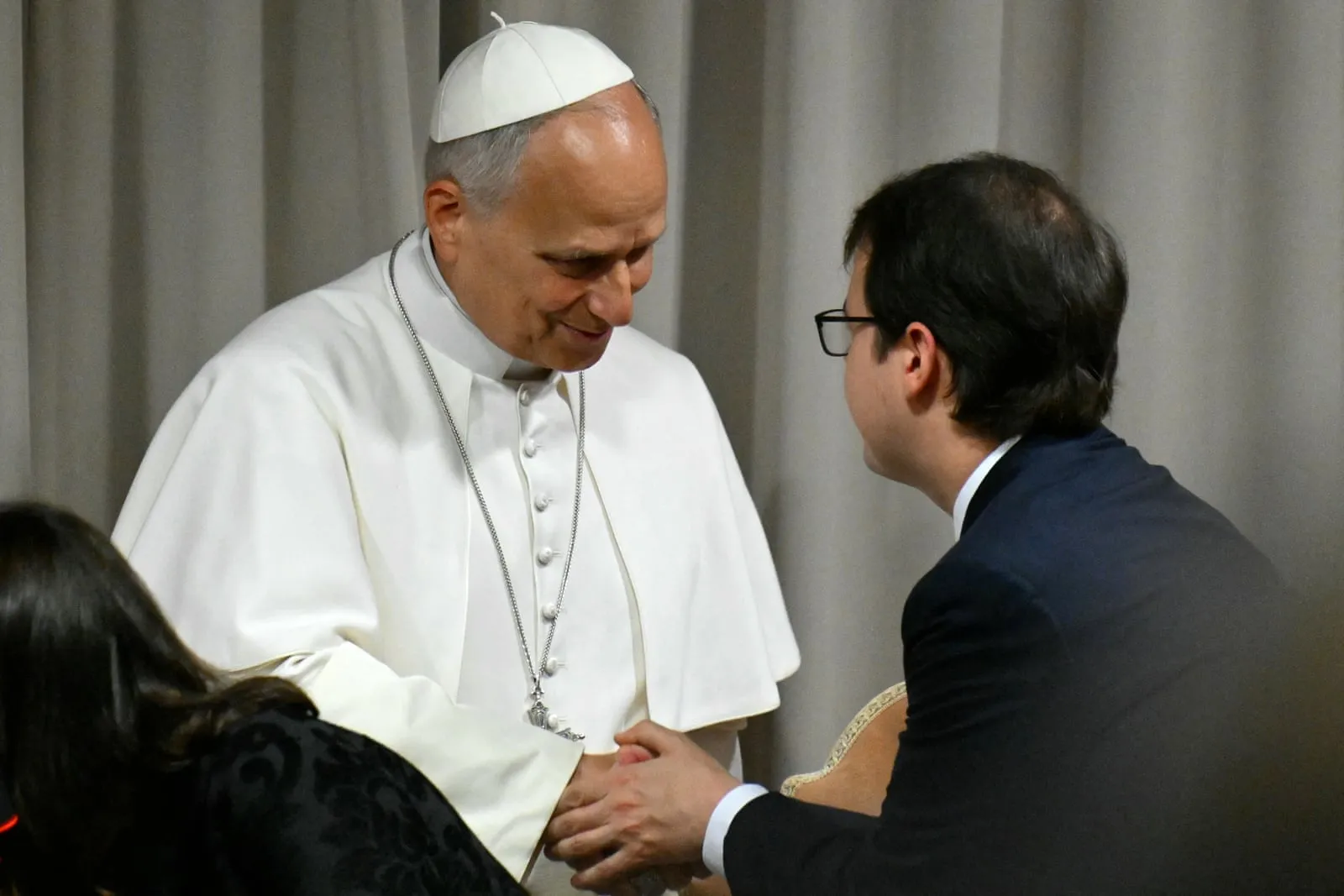
Anthropic’s co-founder, Chris Olah, was with the Pope during the presentation of this first encyclical of Leo XIV, “Magnifica Humanitas”. The reason? It may be the company’s seriousness in involving society in important discussions; it may be a way of creating hype around Claude and its “apocalyptic capability” to inflate its valuation even further.
The encyclical is sharp. Chapters 3 and 4 are secular and address many of the current concerns of society, of parents, of educators and of us devs. In the paragraphs about school, about learning, it talks about the problem of not facing friction (in Portuguese):
140: Education, by contrast, is a long journey requiring patience, and therefore needs time for development and for engagement with reality beyond appearances. This is a fundamental issue because every technology shapes those who use it. Educating people about the use of AI, then, involves teaching them to decide when and for what purpose it ought not to be used. The speed and ease with which answers or summaries can be obtained risk extinguishing the desire to ask questions, which is a process that bears fruit only over time.
As Plato wrote, the deepest and most important things are learned only after much time and effort, by engaging in discussion with others, “striking upon” ideas and experiences together like flint until the spark of understanding is kindled within us.
We must learn, then, how to exercise restraint in the use of AI and to protect our young people from the promise of the perfect machine, from that subtle temptation which renders human thought seemingly superfluous precisely when it is most needed.
The encyclical passages are quoted from the official English translation. The Portuguese one I read is sharper in two places: “friccionar” (to rub, to create friction) where the English says “striking upon”, and “jejum da IA” (fasting from AI) where it says “exercise restraint”.
In a world of hyper-stimuli (in Portuguese), accelerated, attention fragments and makes deep learning and discussion very hard:
- The pervasiveness of digital media fosters a culture of immediacy and hyper-stimulation, which gives rise to fatigue, boredom and apathy concerning the effort required for seeking the truth.
In a society that avoids friction, we will always be afraid of talking to new people, of group gatherings or even of sending an email to the boss without the precise help of some ChatGPT.
And although it doesn’t explicitly mention the hard problem of consciousness, the document talks to the current provocations by Richard Dawkins and to Ted Chiang’s revolt, by criticizing our dream of omnipotence:
- To renounce this adventure, both tragic and splendid, in the name of a presumed transcendence of all limits, could mean many things, but it would no longer be human.
The encyclical doesn’t put it directly, but it connects to our difficulty in being truly present, given that technology has hijacked our attention (in Portuguese):
- The subtler forms of addiction linked to the “digital attention economy” should not be underestimated, since platforms and services are often designed to capture users’ time and attention, exploiting their vulnerabilities and weakening their inner freedom.
- A genuinely healthy attitude is needed, requiring rhythms that incorporate silence, in-depth study, reading and judicious analysis.
What scares me is this outsourcing of decisions and of study (in Portuguese). The line from Karamazov that I wrote down more than 15 years ago comes to mind: “man has no more agonizing concern than to find someone to whom he can quickly hand over that gift of freedom with which the unhappy creature is born… only he who reassures their conscience can take over the freedom of men.” (my translation from the Brazilian edition)
I read several paragraphs of the encyclical on Hipsters #518, and Bill Gates’s article on Hipsters #531 (both in Portuguese).
The discussion (15 comments, in Portuguese) is on the original post.
More in English
- Archetypes instead of professions note · Sep 28, 2026
- AGI, exponentiality and superintelligence note · Sep 25, 2026
- Human Out of the Loop, Asimov and Gradual Disempowerment post · Sep 24, 2026
- My personal knowledge system after six months note · Sep 23, 2026
- Fred Brooks, Fowler and what doesn't change in the profession note · Sep 16, 2026