Translated from Portuguese by Claude. Leia o original em português · more in English
AGI, well-defined tasks and a master's degree in 65 minutes
Jensen Huang welcomed AGI with the arrival of Astra. Personally, I don’t like the term, and it ended up becoming a marketing device, as Sam Altman himself said. And there is a conflict of interest with the big artificial intelligence labs getting close to their IPOs.
That said, we can’t deny what the models have achieved. Well-scoped tasks with enough context can already be carried out end to end by the harness of these models. Filling in forms, doing research, writing texts, clicking through sequences of buttons in apps with no prior knowledge. All of these tasks happen basically without any error. And, at any stumble, the reasoning itself detects it, tests and tries another path. AI’s current critical evaluation of its own work is surprising, to say the least.
For a few months now it has been impressive to watch AI click around your browser, switch tabs, fill in fields and move information from one place to another, in a chained sequence of actions that makes long tasks possible. The Astra launch video shows use cases that go much further:
I believe the term AGI will disappear leaving few traces, just like the Turing test. Notice that we no longer argue whether the Turing test has been passed or not: we simply turned the page and it became a minor question, almost decorative. Arguing over the fine print of Turing’s criteria ends up being just a distraction.
The same may happen with AGI (in Portuguese). We will look back and there won’t be a set date, a specific milestone. We will see rankings, classifiers, recaptchas, cat detection, ChatGPT, self-driving cars and Chinese robots as one continuous block.
When Astra came out, I talked with Fabrício Carraro, host of the podcast IA Sob Controle. He suggested I run a benchmark, and I proposed trying to implement the algorithm from my master’s dissertation, from 20 years ago.
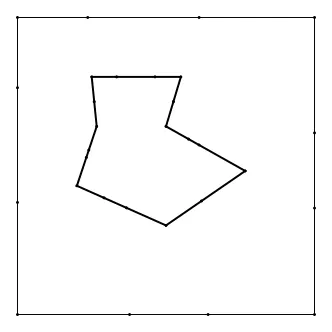
The problem we studied is this: given a polygon drawn on paper, how can we fold it so that all its edges line up and, with a single cut of the scissors, cut out exactly that polygon, so that when you unfold the sheet the hole is the drawing. An interesting magic trick, proven by professor Erik Demaine, from MIT: there is always a solution. He laid out two algorithms in a short and concise paper, where he stated the problem and also the solution.
Rafael Cosentino and I, along with our advisor José Coelho de Pina Jr., spent a year on the paper, also learning computational origami from Robert Lang and geometry from O’Rourke. For about four months we wrote JOrigami. We were young programmers. The algorithm itself isn’t hard, but it is a lot of work, even more so at a time when libraries of computational geometry primitives were less available.
I gave Demaine’s paper as a PDF to Claude (Fable 5.1) to execute. It took a little over an hour and produced this:
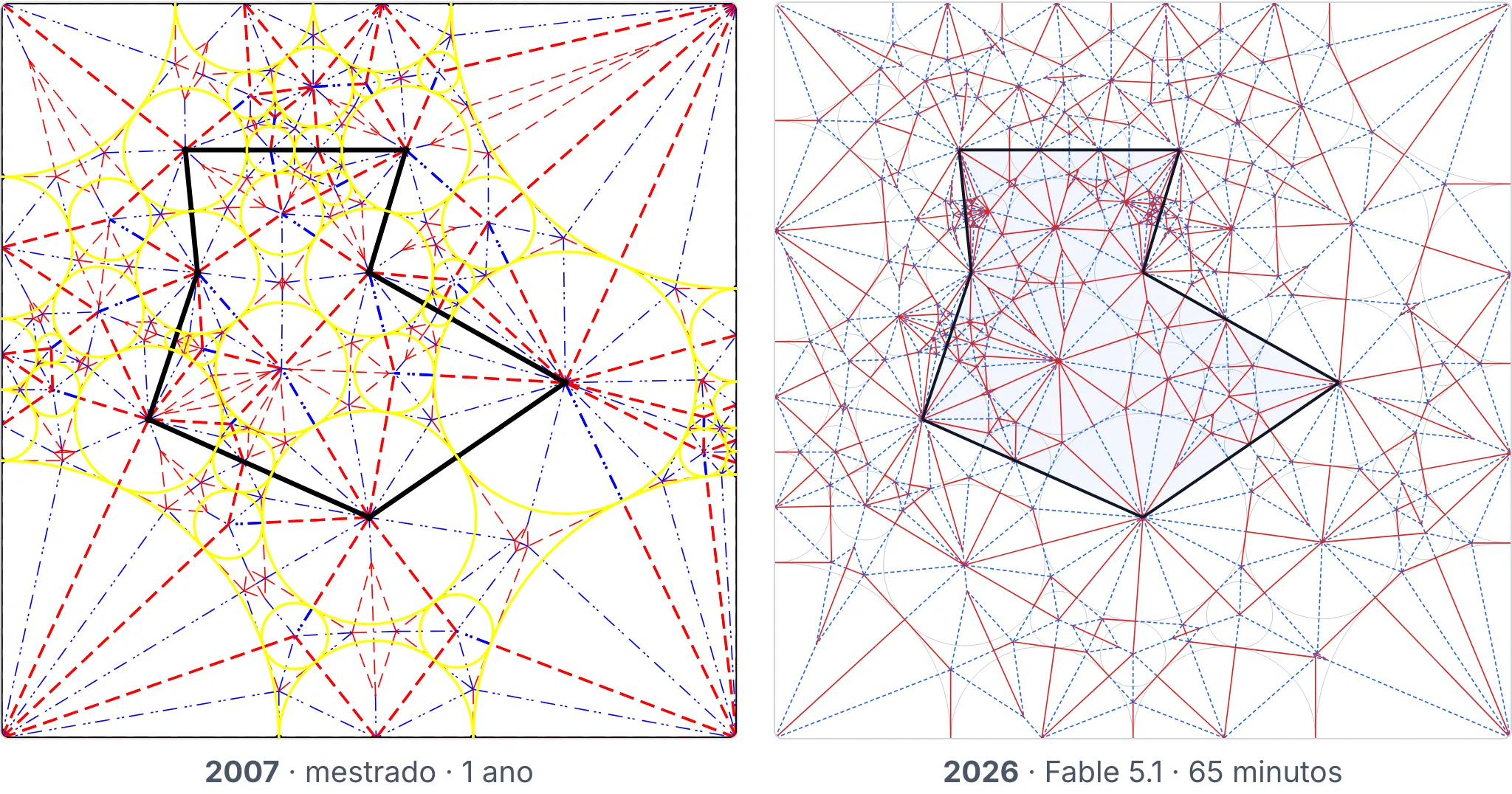
The AI itself explains here how it implemented the algorithm (in Portuguese) and the differences it found from our implementation.
A year of work, five months of programming. The AI did it in 65 minutes. I wasn’t surprised. Nor was I questioning the definition of AGI.
But there are already immediate impacts: we need to understand how we will keep doing science. Some argue that solving Navier-Stokes through traditional methods could have brought other intermediate discoveries. In this note I wrote about the analogy Terence Tao makes (in Portuguese) with the scientific method and the process of discovery. Getting to the result is important, it is valid, and it is very powerful to have access to today’s tools. At the same time, we may be leaving aside important questions, subtasks that could captivate our minds and curiosity. Some people push back, saying that AI itself will also see this and have that mechanism of restlessness. That is not the case now.
The more complex problem remains: the development of juniors’ careers, and I’m not talking only about devs. Their career gets more complicated once well-scoped tasks, like front-end work or database consulting, are executed perfectly by AI. This also happens in science, in my own master’s. When my professor picked this problem, he clearly saw that the paper was feasible to implement for a young person testing his interest in academia and science. It was an interesting computing problem for learning primitives, geometry, combinatorics and a bit of science while we banged our heads and exchanged emails and questions with important researchers.
Where will these simple problems that bring people into science and research go? And in programming, in medicine or in any career where the start involves a lot of repetition, understanding and pattern recognition? Could AI be reducing our productive effort so much that it causes scientific stagnation (in Portuguese)? Without warming up on small problems, who will have the interest and the ability to ask the new, good questions? The Fields medalists, together with Tao, also spoke up this week: “the mass production at faster and faster pace of “true/false” statements could destroy fertile ground instead of breathing life into new ideas”.
My father read the mathematicians’ manifesto and saw in it a defense of how things are done inside an institution, a group. He remembered two cases. The first is the steel axes in Australia, which the anthropologist Lauriston Sharp documented among the Yir Yoront, on Cape York, in the 1930s. The stone axe belonged only to the older men and was traded at ceremonies. When the Anglican mission started handing steel axes directly to women and young people, those ceremonies lost their reason to exist, and their system of myths had no way to fit the new object. The second is firearms among the native peoples of Brazil. At first, only those at the top could use the technology, like the Guarani of the Jesuit missions (in Portuguese), armed with authorization from the King of Spain to fight the bandeirantes. Later, the result started arriving faster, the rituals died, and nobody could hold back the use of these tools anymore.
The manifesto can be read that way, as a defense of the work and rituals of a group. Maybe. But rituals are where much of the tacit knowledge and the social exchange live. How can we reconcile that with progress?
The discussion (55 comments, in Portuguese) is on the original post.
More in English
- Human Out of the Loop, Asimov and Gradual Disempowerment post · Sep 24, 2026
- Fred Brooks, Fowler and what doesn't change in the profession note · Sep 16, 2026
- Open Claw, Personal Knowledge and the Second Brain post · Mar 3, 2026