Translated from Portuguese by Claude. Leia o original em português · more in English
Genealogy, Agent Skills and the Human in the Loop
Every now and then, my urge to map the family genealogy comes back, an obvious privilege when you have the time. It is also an exercise in understanding how everything is documented and catalogued around the world. We can feel that this kind of record is extremely recent and that information is always floating around in a chaotic, misaligned way.
Unstructured data, conflicting information, words full of spelling mistakes, countless sources of truth. Does that remind you of something? It is a feast for LLMs!
I did this research process 10 years ago and, with the arrival of more versatile agents that control your computer, I saw that the tool fit well. Whether OpenClaw, Cowork, or even Codex and Claude Code.
It has been very interesting to work directly in Claude Code: it takes what I had already done of the family tree, which even has its own formats, like GEDCOM, and works on top of that pile of websites. Not only giants like Ancestry and FamilySearch, but also small sites of towns and museums. For that, Claude Code itself searches and makes requests using APIs, and sometimes simulates browsing with Playwright and headless browsers.
In 6 days, I did much more with it than in months back then:
Progress on my tree
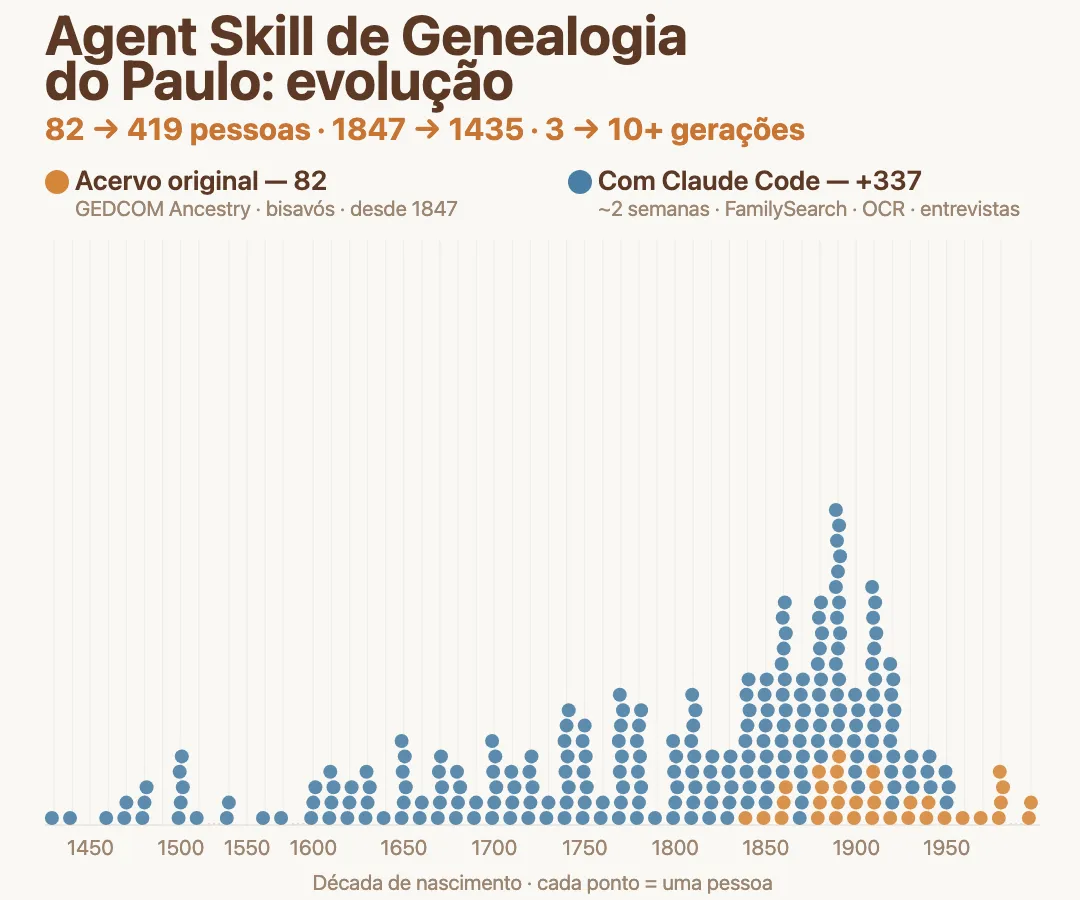
I asked the agent to describe the progress from the tree I had before (built entirely by hand) to what we did in 6 days of conversations:
When we started, we began with a GEDCOM exported from Ancestry with 82 people and a depth of great-grandparents, the oldest born in 1847. In about two weeks of research with Claude Code, cross-referencing the FamilySearch API, OCR of more than 300 documents and interviews with 12 relatives, the collection jumped to 419 catalogued people, going back to Portuguese ancestors from 1435 in the maternal line from São Paulo. The best documented line reaches 10 generations, with parish records from Queirã and Aboadela in Portugal.
The Smalltalk mix
An agent can do very well what I needed here: handle the command line, generate simple scripts and work with the results. We get that mix we have been seeing a lot: source code, execution and database manipulation inside the same environment.
Once again, recalling the provocation Sérgio made: this is a lot like Smalltalk and the like… but this time it is the context of your agent, your Claude Code, your OpenClaw.
"openclaw ta me lembrando dos tempos de smalltalk na faculdade. aquela nocao de mundo stateful com codigo e dados misturados num grande blob que vai evoluindo" - Sergio de novo fazendo muito sentido.
— Paulo Silveira (@paulo_caelum) February 2, 2026
(My tweet, in Portuguese.)
The human in the loop: when the agent is the one asking questions
This exercise of Artificial Intelligence applied to work that isn’t exactly programming or software was a lot of fun.
It is amazing to see how it works: I keep feeding the agent the data I already had: certificates, registry office documents. It searches for information on the internet and brings questions back to me. Questions that need the human. I have to confirm whether a piece of information is correct. Or fetch a certificate from a registry office. Even ask a great-uncle or someone in the family who knows about it. And come back.
This goes back and forth in a continuous loop: on one side me, on the other an agent that mixes code creation, execution and database. All in the same git repository: something considered one of the worst software engineering practices, right?
Disposable software
But I say it again and link to my post about perishable software. These little systems we create, use and throw away will be more and more common. Actually: they were already common, now the cycle will be shorter and more intense.
These practices will appear very organically and we will no longer distinguish so clearly what is operating system, what is app, what is data, whether it is a temporary script or not… Sure, it will take time and maybe it won’t be exactly like this, but there will be more and more software for extremely particular use. Everybody will be a programmer (of skills with markdown? I will talk about it) or technologist, or citizen developer (in Portuguese), or some future term that catches on better.
How do you reuse software this coupled?
Some friends asked me for help with their trees, excited about the results. Sharing my GitHub repository wouldn’t work well, since it is tied to my files and my genealogy (in fact, the YAMLs I use to represent each person are in the same repository as the scripts, all mixed up!).
I believe that, in the near future, we will stop sharing scripts and small personal programs, and truly exchange Markdown files that define agent skills.
That is why I asked Claude Code to generate, in one shot, a shareable skill. Here is the initial genealogy skill, along with my prompt and the agent’s notes. It came out almost perfect, but it leaked a bit of context and idiosyncrasies of my family.
I iterated a bit and made the official publication of the genealogy skill here. Just hand this link to your Claude Code (or any other agent, try sending it to your OpenClaw!) and ask it to start unraveling your genealogy. I will be honored to hear how far you got with yours, using this little file!
The discussion (5 comments, in Portuguese) is on the original post.
More in English
- Archetypes instead of professions note · Sep 28, 2026
- AGI, exponentiality and superintelligence note · Sep 25, 2026
- Human Out of the Loop, Asimov and Gradual Disempowerment post · Sep 24, 2026
- My personal knowledge system after six months note · Sep 23, 2026
- Fred Brooks, Fowler and what doesn't change in the profession note · Sep 16, 2026